Corporate Governance
The Board of Directors believes that good corporate governance is a key factor in enhancing operational efficiency, fostering long-term sustainability, and maximizing value for the company. It also serves to strengthen the confidence of all stakeholders through transparent and equitable disclosure of information.
In this regard, the Board of Directors has appointed a Corporate Governance Committee to oversee compliance with the principles of good corporate governance as prescribed by the Stock Exchange of Thailand, the international standards of the Organisation for Economic Co-operation and Development (OECD), and the ASEAN CG Scorecard. The committee is also responsible for driving the practical implementation of these principles and continuously monitoring performance to ensure alignment with the company’s established corporate governance framework.



Goal and Performance Highlights

- There will be zero incidents of non-compliance with laws and regulatory requirements.


Challenges and Opportunities
The Board of Directors committed to the principle that good corporate governance enhances operational efficiency and supports long-term business sustainability. It aims to maximize value and build trust among all stakeholders through transparent and equitable disclosure of information, while giving due consideration to all stakeholder groups. The Board has appointed a Corporate Governance Committee to oversee and ensure that the Company’s governance practices align with the principles of good corporate governance as prescribed by the Stock Exchange, international standards of the Organization for Economic Co-operation and Development (OECD), and the ASEAN Corporate Governance Scorecard.

The Committee is also responsible for ensuring the effective implementation of these governance principles and for continuously monitoring performance in accordance with the Company’s corporate governance plan.
Management Approach and Value Creation
The Company adheres to the Principles of Good Corporate Governance for Listed Companies (2017). The Board of Directors conducts a review and assessment of the Group’s corporate governance policy at least once annually to ensure alignment with applicable laws, regulations, and best practices, as well as to enhance effective implementation on an ongoing basis. In addition, the Board has established a mechanism to regularly monitor compliance with the corporate governance policy and related best practice guidelines to ensure consistent and effective adherence across the organization.
In 2025, the Company monitored and reviewed its corporate governance policy and related practices. The revised policy was approved at the Board of Directors’ Meeting No. 5/2025, held on 11 December 2025. The Company subsequently communicated the policy to all directors, executives, and employees via email and the Company’s internal information system (Intranet). In addition, the policy was disclosed to shareholders, investors, stakeholders, and the public through the Company’s website atwww.assetwise.co.th
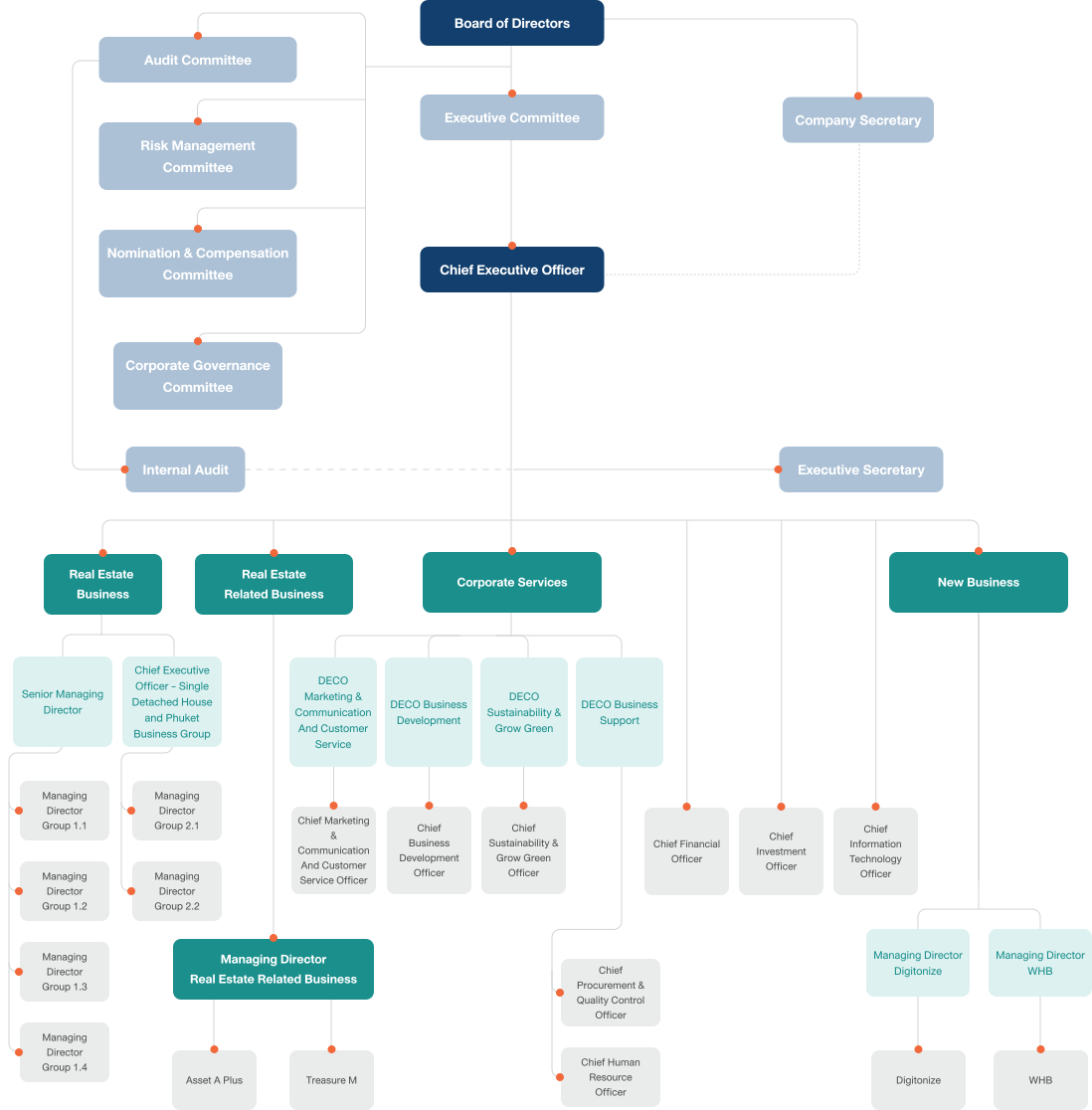
The Company’s corporate governance structure comprises the Board of Directors and five subcommittees, namely the Audit Committee, the Nomination and Remuneration Committee, the Corporate Governance Committee, the Risk Management Committee, and the Executive Committee.


Board Composition
As of 31 December 2025, the composition of the Board of Directors is as follows:

Board Diversity
The Company has established a Board Diversity Policy to ensure that directors possess qualifications in accordance with relevant criteria. The Board’s diversity is assessed to ensure it is appropriate and aligned with the nature of the Company’s business, taking into consideration a broad range of attributes, including skills, knowledge, capabilities, experience, expertise, and specialized competencies. Such diversity also encompasses essential skills that support the Company’s operations and are consistent with its short-term and long-term business strategies. This is implemented through the development of a Board Skills Matrix, which outlines the knowledge, skills, and experience of each director. Currently, the Company has one non-executive director with professional experience directly related to the Company’s business.
The Chair of the Board is an independent director and is not the same individual as the Chair of the Executive Committee or the Chief Executive Officer. This structure ensures a clear segregation of roles and responsibilities, as well as an appropriate balance of power in the Company’s management. In this regard, the Company’s Chair is Mr. Sarawut Jarujinda, an independent director, while Mr. Kromchet Wiphanphong serves as Chief Executive Officer.
Board Gender Diversity Policy, The Company has established a gender diversity target for the Board of Directors, requiring at least two female directors. In 2025, the Company had two female directors, representing 22.22% of the total Board composition.
As of 31 December 2025, the Board of Directors comprised a total of nine members, as follows:
| Name | Position | Type of Director | Board Skills Matrix |
|---|---|---|---|
| Mr. Sarawut Charuchinda | Chairman of the Board of Directors / Chairman of Risk Management Committee | Independent Director | Administration and Management Skill / Finance and Investment Skill / Risk Management Skill |
| Mr. Kromchet Vipanpong | Director / Risk Management Committee / Corporate Governance Committee / Chairman of the Executive Committee | Executive Director | Real Estate Business Skill / Engineering Skill / Administration and Management Skill / Risk Management Skill |
| Mr. Weerapan Wipanpong | Director / Corporate Governance Committee / Deputy Chief Executive Officer-Business Development | Executive Director | Real Estate Business Skill / Architectural Skill / Administration and Management Skill |
| Ms. Paneeta Malaivongs | Director / Nomination and Remuneration Committee / Deputy Chief Executive Officer-Sale and Marketing | Executive Director | Administration and Management Skill / Sale and Marketing Skill / Human Resource and Assessment Skill |
| Ms. Tidarat Kanchanawat | Director / Chairman of Nomination and Remuneration Committee | Independent Director | Administration and Management Skill / Human Resource and Assessment Skill / Economics Skill |
| Asst.Prof.Dr.Kriengkrai Boonlert-U-Thai | Director / Chairman of Audit Committee | Independent Director | Administration and Management Skill / Accounting Skill / Aditing Skill / Acabemic Posittions Skill |
| Prof. Dr. Nopadol Rompho | Director / Audit Committee / Chairman of Corporate Governance Committee | Independent Director | Administration and Management Skill / Accounting Skill / Human Resource and Assessment Skill / Acabemic Posittions Skill |
| Mr. Kobkiat Tananchaya | Director / Audit Committee | Independent Director | Administration and Management Skill / Risk Management Skill / Legal Skills |
| Mr. Suchet Ritteephamorn | Director | Non-Executive Director | Real Estate Business Skill / Administration and Management Skill / Sale and Marketing Skill |
Subcommittees
Audit Committee
| Name | Position | Type of Director | Board Skills Matrix |
|---|---|---|---|
| Asst.Prof.Dr. Kriengkrai Boonlert-U-Thai | Chairman of Audit Committee | Independent Director | |
| Prof. Dr. Nopadol Rompho | Audit Committee | Independent Director | - |
| Mr. Kobkiat Tananchaya | Audit Committee | Independent Director | - |
Risk Management Committee
| Name | Position | Type of Director |
|---|---|---|
| Mr. Sarawut Charuchinda | Chairman of Risk Management Committee | Independent Director |
| Mr. Kromchet Vipanpong | Risk Management Committee | Executive Director |
| Mr. Kobkiat Tananchaya | Risk Management Committee | Independent Director |
Nomination and Remuneration Committee
| Name | Position | Type of Director |
|---|---|---|
| Ms. Tidarat Kanchanawat | Chairman of Nomination and Remuneration Committee | Independent Director |
| Prof. Dr. Nopadol Rompho | Nomination and Remunerationt Committee | Independent Director |
| Ms. Paneeta Malaivongs | Nomination and Remunerationt Committee | Executive Director |
Corporate Governance Committee
| Name | Position | Type of Director |
|---|---|---|
| Prof. Dr. Nopadol Rompho | Chairman of Corporate Governance Committee | Independent Director |
| Mr. Kromchet Vipanpong | Corporate Governance Committee | Executive Director |
| Mr. Weerapan Wipanpong | Corporate Governance Committee | Executive Director |
Executive Committee
| Name | Position | Type of Director |
|---|---|---|
| Mr. Kromchet Vipanpong | Chairman of Executive Committee | Executive Director |
| Mr. Weerapan Wipanpong | Executive Committee | Executive Director |
| Ms. Paneeta Malaivongs | Executive Committee | Executive Director |
The Nomination and Renumeration Committee considers structure and composition of remuneration for the Board of Directors and subcommittees every year by proposing criteria in determining remuneration suitable for roles and responsibilities of the Board of Directors and subcommittees including individual performance of directors, business plan and the Company’s business performance. The remuneration must be comparable to and competitive with other companies in the same industry or other listed companies in the Stock Exchange of Thailand.
Note that remuneration for the Board of Directors and subcommittees includes monthly compensation for directors and meeting allowance for each subcommittee member as categorized by the position as chairman, non-executive director and executive director. Monthly compensation and meeting allowance will be deliberated by the Nomination and Renumeration Committee on annual basis before proposing to the Board of Directors for approval and to be presented to the shareholders’ meeting for consideration and approval.
The remuneration of the Board of Directors and subcommittees for the year 2025 was approved by the shareholders at the 2025 Annual General Meeting of Shareholders held on 24 April 2025, consisting of the following:
Monetary Remuneration
- The Board of Directors, comprising non-executive directors, receives fixed remuneration, including a monthly retainer and meeting allowances payable only to directors who attend each meeting.
- The Company also provides a performance-based bonus for the Board of Directors, which is considered variable remuneration. Such bonus is determined based on the Company’s performance or operating results, within a maximum limit of Baht 1,000,000.
- Sub-committees, including the Audit Committee, the Nomination and Remuneration Committee, the Corporate Governance Committee, and the Risk Management Committee, receive fixed remuneration in the form of meeting allowances, payable only to non-executive directors who attend the respective meetings.
Non-monetary Remuneration
- Non-monetary remuneration provided by the Company to the Board of Directors includes group health insurance coverage.
The Company discloses directors’ remuneration on an individual basis for 2025 in the 56-1 One Report 2025.
The remuneration of the Chief Executive Officer and Top Executives is determined by the Nomination and Remuneration Committee, which reviews the structure, criteria, and components of remuneration on an annual basis. The Committee proposes remuneration principles that are appropriate to the roles and responsibilities of the Chief Executive Officer and senior executives, ensuring that such remuneration is fair, reasonable, and competitive when benchmarked against companies in the same industry and other listed companies on the Stock Exchange of Thailand.
The proposed remuneration principles and amounts are then submitted to the Board of Directors for consideration and approval.
Remuneration for the Chief Executive Officer and Top Executives includes annual salary adjustments and bonus payments aligned with performance evaluations for the current year (short-term), as well as performance against the Company’s long-term strategies and targets.
In addition, the Company provides long-term, performance-linked remuneration, including a share accumulation plan designed to support long-term benefits. This approach aims to encourage decision-making that supports the supports the sustainable growth and long-term interests of the organization.
The performance evaluation of the CEO and top executives considers both financial performance and non-financial performance in accordance with the Company’s operational plans, targets, and strategies presented to the Board of Directors. The evaluation also takes into account management capabilities and organizational leadership. Furthermore, the Company has established performance indicators for the CEO and top executives to support sustainable business development, covering Environmental, Social, and Governance (ESG) aspects, with the objective of achieving Carbon Neutrality and Net Zero targets as set by the Company.
Details of compensation for the CEO and Top Executives include
- Fixed Remuneration: Includes salary, determined in accordance with the Company’s salary structure and employee benefits policy.
- Variable Remuneration: Includes the annual bonus, which varies based on the Company’s performance and individual performance evaluations.
- Other Benefits: Include provident fund contributions, group health insurance, and the right to purchase the Company’s shares under the Employee Joint Investment Program (EJIP).
The Board of Directors oversees potential conflicts of interest within the Company and has established a policy to prevent such conflicts. All directors and executives are required to declare their interests and submit a report of interests to the Company Secretary.
In considering any matters, decisions must be made based on the principle that all business activities are conducted in the best interests of the Company. Directors and executives are expected to avoid any actions that may give rise to conflicts of interest. Any individual who has an interest in a matter under consideration must disclose the nature of such relationship or interest to the Company and must abstain from participating in the deliberation and decision-making process, as well as having no authority to approve such transactions.
In the event of transactions that may give rise to conflicts of interest and are not conducted under normal commercial terms, such transactions must be submitted to the Board of Directors for approval. The Audit Committee is responsible for carefully reviewing the appropriateness of such transactions before submitting them to the Board of Directors and/or the shareholders’ meeting (as applicable).
In addition, the Company has established guidelines on conflict of interest prevention for directors, executives, and employees. These guidelines are communicated through the Company’s communication channels and are consistently applied across the organization.
The Company discloses transactions with related persons or connected parties for 2025 in the Form 56-1 One Report
Stakeholders Directly Impacted