

Risk Management
The company recognizes the importance of enterprise risk management as a key factor in achieving its defined objectives and goals. It also supports good corporate governance and promotes stable and sustainable growth.
Accordingly, the company has established risk management policies, structures, and procedures to serve as guidelines and a framework for all departments, ensuring efficient and consistent implementation across the organization.

Goal and Performance Highlights

- to implement risk management in accordance with the COSO ERM framework across all processes throughout the Company’s value chain.


Challenges and Opportunities
The Company places significant importance on risk management to ensure the achievement of its strategic objectives. A Risk Management Committee has been appointed to establish the Company’s risk management policy and to ensure that an effective risk management system is implemented across the organization. This enables the Company to adequately and appropriately assess and manage risks that may impact its business operations.

The Risk Management Committee is responsible for overseeing and managing enterprise-wide risks. The Company conducts comprehensive risk identification and analysis covering both current operations and new investments, taking into account economic, social, and environmental factors in alignment with sustainable development principles.
Furthermore, the Company has established processes for risk assessment, monitoring, control, and reporting. Risk reports are submitted to the Risk Management Committee on a quarterly basis, while emerging risks are continuously monitored to minimize potential impacts and ensure that risks are maintained within acceptable levels.
In addition, the Company conducts an annual review of its risk management framework, key risk factors, risk appetite, and key risk indicators (KRIs), as well as related risk mitigation plans. These are proposed to the Risk Management Committee for consideration and subsequently submitted to the Board of Directors for approval.
In the event of significant or urgent changes, the Company will convene meetings with the Risk Management Committee to review and reassess risks, determine appropriate risk control measures, and promptly report to the Board of Directors.
Management Approach and Value Creation
The Company is committed to conducting business under the policy of good corporate governance. The Company adopts the Enterprise Risk Management (ERM) principle in accordance with the risk management framework of the Committee of Sponsoring Organizations of the Treadway Commission (COSO), a universal standard of risk management, as a guideline in the Company’s risk management.
The Company has also implemented risk management, conducting risk management in regard to the organization as a whole. Risks are identified from analysis and assessment of external factors such as business environment analysis as well as analysis of industrial competition conditions from various factors related to the real estate business.
Moreover, risks are also identified from internal factors, from business strategies, objectives, and procedural operations to the various supporting units within the organization. All directors, executives, and employees in all levels appropriately apply risk management as well as are aware of the responsibilities in accordance with risk management policy, so as to achieve effective risk management to the maximum extent.
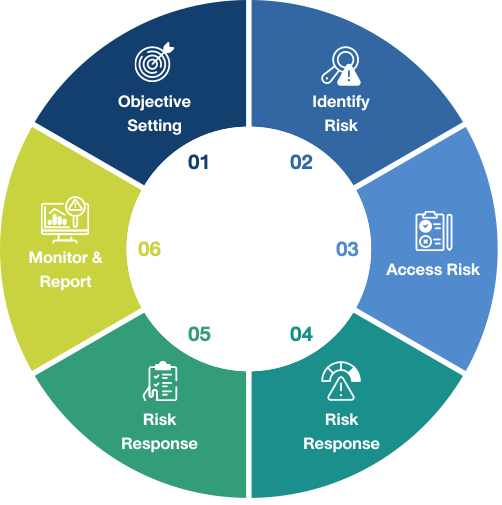
The Company applies the universally accepted COSO ERM Framework in the following 6 risk management steps.


Risk Management Structure
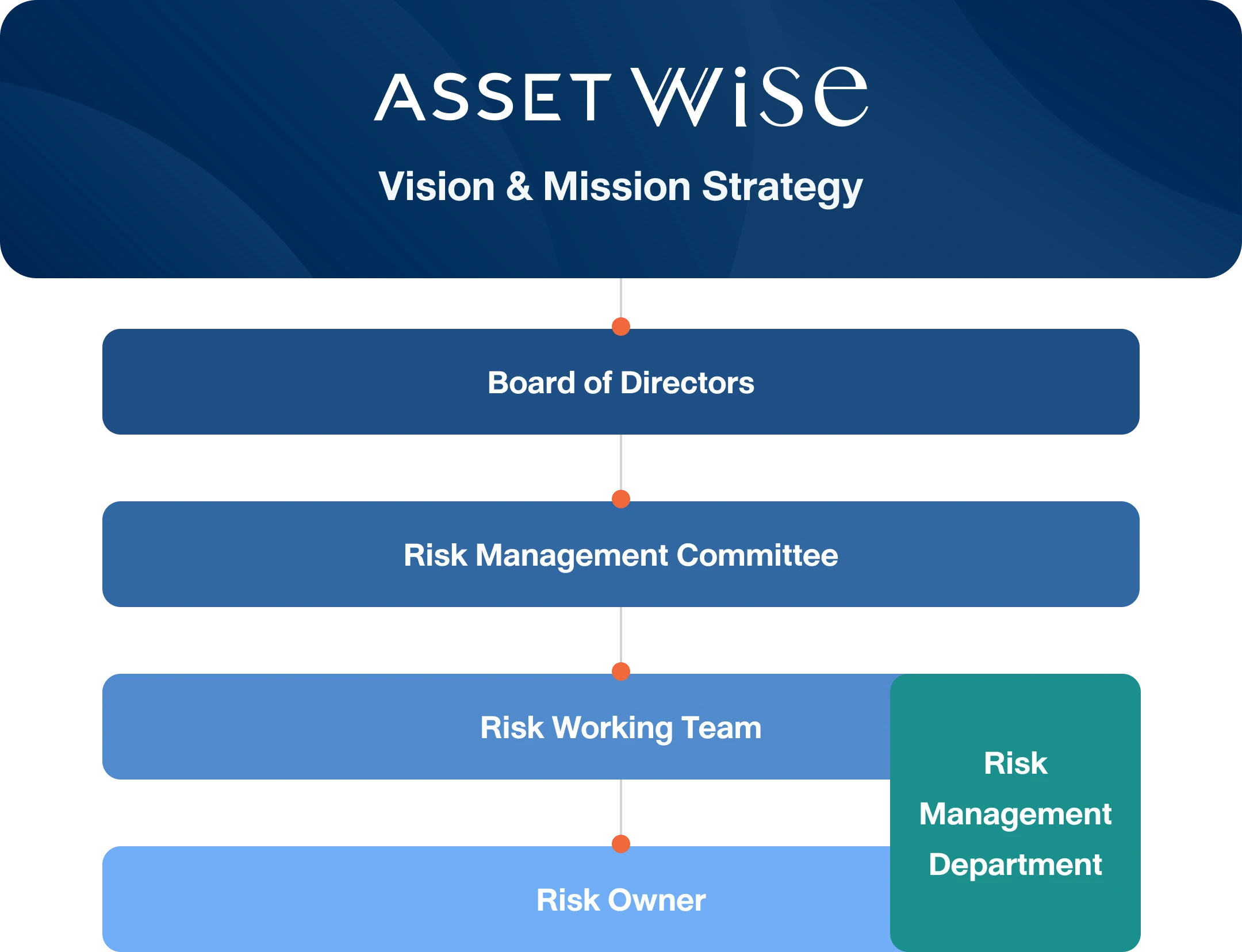
The Board of Directors is responsible for overseeing enterprise-wide risk management, including sustainability-related risks (Environmental, Social, and Governance: ESG), in alignment with the Company’s vision, mission, and sustainable business strategy. The Board establishes the risk management framework and regularly reviews the effectiveness of the risk management processes.
The Board of Directors has approved the establishment of a Risk Management Committee, comprising three directors, including two independent directors, to specifically oversee the Company’s risk management. The Committee is responsible for monitoring the implementation of the risk management system, as well as reviewing the Company’s risk management plans and performance to ensure that risks are maintained at an appropriate and acceptable level.
Three Lines of Defense

First Line of Defense - Operational Functions

Second Line of Defense - Risk Oversight and Support Functions

Third Line of Defense - Independent Assurance
In addition, the Company’s Risk Management function operates independently from the Internal Audit function, and the Risk Management Committee is clearly segregated from the Audit Committee to ensure appropriate governance and oversight.
Stakeholders Directly Impacted


